Our blog has moved!

You should be automatically redirected in 6 seconds. If not, visit
http://thepost.emory.edu/
and update your bookmarks.

Showing posts with label Emory Sports. Show all posts

Thursday, February 24, 2011

What are you doing Saturday afternoon?


At 4:00 p.m., write down “watching the Emory men’s basketball game.” Whether you live in Atlanta and can attend in person or are outside the city and access the live stats, don’t miss the Eagles’ final game of the year when they host Rochester. At 19–5 (10–3 UAA), second place in the conference is assured, but a NCAA tournament bid could be on the line. 2010–11 is already Emory’s most successful campaign in 20 years.

An OT loss on the road last weekend at Carnegie Mellon torpedoed any chance for the Eagles to challenge for a University Athletic Association (UAA) title that they haven’t won since 1990, but that’s just a small blip on what has been a stellar season.

All year, head coach Jason Zimmerman has instilled in his team a sense of discipline and smart play that’s refreshing, and unleashed an offense that can score points in huge bunches either in transition or the half court.

Leading the way is junior point guard Austin Claunch (16.2 ppg, 7.4 apg), who not only paces the team in scoring, he is one of the nation’s leaders in assists, owns a 2.95 assist-to-turnover ratio (excellent), and after setting the school record for assists in a game (12) in the fall, he tied it twice in the spring.

Claunch (pictured above with no. 21 Corey Spraggins) is certainly one of the reasons why the Eagles are good this year, but they are also a lot of fun to watch. Sophomore Alex Greven (14.8 ppg, 3.5 rpg) sinks shots that most of us wouldn’t even try in games of HORSE, 6-foot-6 sophomore post player Michael Friedberg (8.2 ppg, 6.0 rpg, 2.2 bpg) has developed into a force inside, junior Alex Gulotta (11.8 ppg) is a sniper from outside (he hits 46.4% of his three-point attempts), and freshman Jake Davis is the team’s leading rebounder (6.5 per game) and third-leading scorer (13.6 ppg) even though he doesn’t start.

And the team is going to be good next year, too. Really good. The Eagles graduate just two seniors, and only one of them, Julien “Juice” Williams (8.1 ppg, 4.8 rpg), an excellent two-way player, is a starter.

A win against Rochester, the conference champion and the No. 14 team in the nation according to d3hoops.com, could mean a great deal for Emory, which is a bubble team for the Div. III national tournament.

The Emory women’s game against Rochester kicks off the doubleheader at 2:00 p.m. Since it’s the last game of the year for both teams—and home courts really do offer an advantage—let’s send the regular season off in style.

-- Eric Rangus, director of communications, EAA

Wednesday, February 9, 2011

Photo of the Day: Thinking Pink

Today's Wonderful Wednesday featured a whole lot of pink. Besides Valentine's Day being less than a week away, Emory groups were supporting breast cancer awareness and research as part of the annual Think Pink week.

Student athletes and members from the Student Programming Council (SPC) sold pink scarves and bow ties to students to raise money for breast cancer research at the Winship Cancer Institute.

This all leads up to the Pink Tie Affair Saturday, February 12, for a sock-hop-themed night of food, music, and dancing. Scarves and bow ties will again be sold at the event.

Sunday, we'll be cheering on the women's basketball team during their annual Think Pink game at 2:00 p.m. at the WoodPec. The Eagles face the University of Chicago.

You can read more about the week's Think Pink events in the Emory Report.
Photo by Stephanie Chan 14C

Thursday, July 29, 2010

Emory's own World Cup in Washington, DC

GOOOOALLLL!

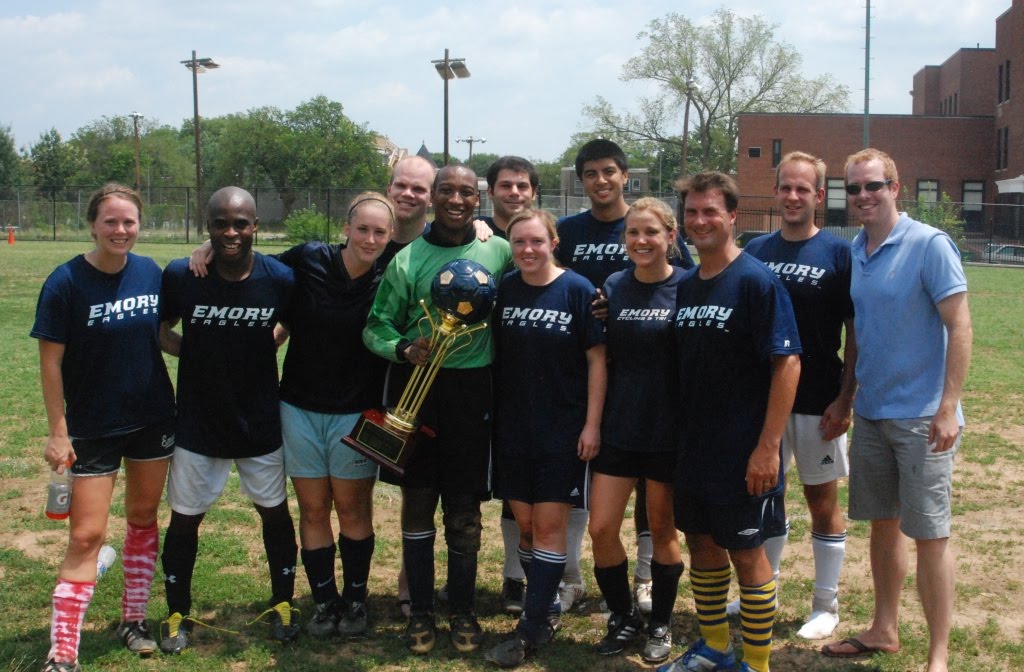
The Emory alumni soccer team in Washington has been successful in not only keeping up their Emory spirit, but also in stomping other alumni soccer teams.

I had the opportunity to speak with one of the players, Krister Holladay 90C, who updated me on the team’s progress and success.

The Washington, DC Chapter of Emory Alumni, first joined the Capital Alumni Network (CAN) co-ed 7 vs. 7 soccer league three seasons ago. They were first coached by Steven Hunt 98Ox 01PH and his wife, Heather. Rob Rutland-Brown 01C coached the team with Tahir Duckett 08C last year, and in 2010, Duckett and Dana Alsen 06C led the squad.

Under their leadership, the Eagles alumni soccer team recently won the CAN sports league 7 vs. 7 soccer championship! “It was a long, hot couple of back-to-back games, but well worth it,” Holladay said.

The Eagles finished the regular season with five wins and three losses, but really hit their stride in the playoffs, first defeating Tulane (5-0), then Boston College (3-2, OT). In the semifinals, the Eagles started off slow in the sweltering summer heat against Elon College. Elon scored the first goal and then a second goal on a penalty kick in the first half to take a 2-0 lead.

However, the Eagles soared back in the second half scoring three unanswered goals, the clincher from Drew Mincheff’s 06C, to cap a 3-2 come-from-behind win.

After a much-needed half-hour rest, the Eagles took to the field again for the championship game and quickly scored two goals against Wisconsin. Emory dominated the rest of the game crushing the Badgers 4-1 to win its first CAN soccer title thanks to Philip Goo’s 06C hat trick and a goal from Jeff Collins 06C.

“I moved to Washington after college and found myself working in a small office of five people,” Alsen said. “Involvement in the alumni community was an opportunity to broaden my social circle and make friends in a new town.

“With the CAN team sports, it has been a way to see a group of alumni on a weekly basis, allowing us to get to know each other while working together as a team,” she continued. “And it’s been a great way to celebrate the blue and gold.”

Not only is being a part of the Emory alumni soccer team a way to meet new people, it is a good way to “win with class, have unselfish play, and perform with hard work,” Duckett said. “To win a championship in any sport you have to like your teammates, and that's never been truer for me than with this team.”

The rewarding experience of being a part of the Emory alumni soccer team stretches far beyond a championship. “Our Emory bonds have stayed with us long after we left campus, and that shared loyalty to Emory provides an instant network of friends who socialize, play, and in some cases, work together,” Holladay said. “The DC alumni group is a dynamic, diverse, and talented group of people of which I very much enjoy being part. We had a great soccer team this past season and winning the championship against our friends from other peer institutions was really a great feeling.”

Learn more about DC's CAN alumni softball team ...

-- Farah Shackelford, communications intern, EAA

Monday, April 5, 2010

Field of dreams


Today is Opening Day here in Atlanta for the hometown Braves , who face the Chicago Cubs at 4:10 p.m. at Turner Field. So there's no better time for a baseball post ...

The late W. Clyde “Doc” Partin 50C 51G was a beloved Emory icon for more than 50 years—a teacher, coach, athletics director, and historian known for his remarkable contributions to the athletics program. Now that his family has given his personal papers, books, and sports memorabilia to Emory’s Manuscript, Archives, and Rare Book Library (MARBL), he will have a permanent place within the University.

Keep reading for more about the Partin papers. or you can click here for the full story. That is unless you're watching the Cubs/Braves game, which is OK by us ...

-- Eric Rangus, director of communications, EAA

Partin’s son Clyde Partin Jr. 78C 83M 86MR , an Emory alumnus, physician, and professor who has been a member of the MARBL Literary Collections board for the past 10 years, was instrumental in arranging the gift. He and his mother, Betty Partin, and his two siblings, Keith Partin of Charlotte, N.C., and Betsy Partin Vinsor of Gainesville, Fla., are making the gift as a family.

Partin said the family has been touched by Emory’s welcoming response. “We are incredibly pleased that Emory has shown an interest in preserving the sports collections of my father. He was a keen competitor who was devoted to Emory University, the study of baseball, and the history of athletics.”

The archive includes essays Doc Partin wrote about baseball Hall of Famers such as Babe Ruth, Earle Combs, and Frank Robinson, as well as drafts and research notes for those essays. It also includes posters, documents, and baseballs signed by Hank Aaron, Satchel Paige, Buck O’Neill, and many other legendary players, along with a substantial collection of books related to African American athletes.

These materials will form the nucleus of what the Partin family hopes will evolve into a major collection exploring the role of African Americans in sports and the role of athletics in the struggle for human and civil rights.

“Doc Partin had a hand in nearly every major athletic development in Atlanta for years, from the Atlanta Braves to the Olympics,” said Randall Burkett, curator of MARBL’s African American collections. “One of the lesser known but profoundly important aspects of Partin’s career was his eagerness to break down barriers to the success of African American athletes in sports at every level.”

The Partin archive also includes extensive records related to the Atlanta Chiefs, the soccer team from the late 1960s that was the brainchild of Partin’s close friend Richard Cecil, a former executive with the Atlanta Braves. Cecil played a key role in conceiving the idea of a sports archive at Emory.

Partin earned a bachelor’s degree from Emory in 1950 and a master’s in education in 1951. During his tenure as athletics director from 1966 until 1983, Emory athletics saw unprecedented growth that culminated in the construction of the Woodruff P.E. Center, which opened in 1983. He expanded the number of intercollegiate sports, particularly for female students, with women’s tennis being added in 1975 followed by women’s cross-country and track and field in the early 1980s. Partin also founded the Emory Sports Fitness Camp, now in its 45th year.

From 1986 until his retirement in 2002, Partin was a professor of physical education. Over the course of his career, he mentored hundreds of young student athletes. Even after his retirement, he kept an office on campus and often manned the press box, announcing during Emory baseball games. Partin’s book on the history of Emory athletics, Athletics for All: The History of Sports at Emory, was released in 2006. He passed away in June 2009.

Wednesday, March 31, 2010

What victory looks like


Meet the Victory Bell.

Most days, it lives a laid-back life, tucked comfortably in the shadow of the McLarty Staircase at the Miller-Ward Alumni House (MWAH). But one night a year, it emerges as the centerpiece of one of the largest celebrations of Emory's athletics teams.

The Victory Bell Celebration to honor senior student-athletes took place at MWAH, Monday night, March 29, and more than 100 athletes and coaches came out to congratulate student-athletes representing each of Emory's 16 varsity sports.

Following a welcome from Director of Athletics and Recreation Tim Downes, keynote speaker Jenn Hildreth Riehn 99C, a three-sport athlete as a student and now a commentator for Fox Sports South, delivered a brief, engaging speech, in which she, in part, credited her athletics experience at Emory for helping her get to where she is now.

"Being an athlete helped me in my career; it gave me credibility," said Hildreth Riehn, who experienced her greatest Emory success on the soccer field (a goalkeeper, she is tied for fourth all-time in wins).

Then came the ringing of the bell. Actually ... let me back up a bit.

The Victory Bell ceremony is a young tradition here at Emory, but the bell itself has an interesting history. During World War II, more than 3,500 alumni and former students served in the military, and 121 lost their lives. In 1945, to honor Emory's contributions to the war effort, a 10,700-ton cargo ship was christened the Emory Victory, and on that ship, was the Victory Bell.

During the Korean War in the early 1950s, the Emory Victory returned to service. Following that conflict, the bell was sent to Emory as a memento. The Emory Victory went on to serve as a supply ship in the Pacific for more than 20 years. In 2001, the bell moved to the Miller-Ward Alumni House, where it remains today.

Seniors and coaches from each team took turns ringing the Victory Bell, but the number of rings allotted to each team depended on a few things.

Each bell ring represents one of six accomplishments: academic excellence, representing Emory in intercollegiate competition, winning a UAA championship, representing Emory in post-season competition, earning a top 10 final ranking, and winning a team or individual national championship.

For the 2010 ceremony, the women's swimming and diving team (by virtue of its recent national championship) and women's tennis team (courtesy of junior Lorne McManigle's 2009 singles title) earned the maximum six rings. In all, the bell was rung a combined 54 times.

And the Victory Bell is a lot louder than it looks.

See the photos from the Victory Bell Ceremony on the EAA's Facebook fan page.

-- Eric Rangus, director of communications, EAA

Monday, February 22, 2010

Hoop dreams

Sunday was senior day for Emory's men's basketball team--the last home game of Daniel Curtin's, Chad Hixon's, and Anthony Fernandez's college careers--but it was a freshman who led the way to the Eagles' most dramatic victory of the season, a 64-63 win over University Athletic Association rival Brandeis.

Alex Greven (left) a freshman from Winston-Salem, NC, hit a pull-up jumper with five seconds left to seal the come-from-behind Emory victory. It was a thrilling way for the Eagles (15-9, 7-6 UAA) to cap the home portion of what has been a pretty solid season. Just one game remains, a road date with the University of Rochester (14-10, 5-8 UAA).

The Emory men currently sit tied for third in the conference, and a win on Saturday, combined with a loss by Brandeis against NYU, would earn the Eagles a tie for second place in the conference. That would be Emory's best UAA finish since a conference championship in 1990.

Before some of the current team's players, like Greven, were born.

A win on Saturday would also give the Eagles their first a winning record in the UAA, one of Division III's toughest, since 2001. Quite a season for third-year coach Jason Zimmerman.

Sunday was also a big day for the women's basketball team, which celebrated its third-annual Think Pink game for breast cancer awareness. The result wasn't quite as positive as it was on the men's side, though, as Brandeis (15-8, 8-5 UAA) walked away with a 58-38 victory.

Still, it was nice to see the largest crowd of the season come out to see the Emory women (10-14, 3-10 UAA), who have shown flashes of brilliance in 2009-10 but also long stretches of inconsistency.

With the gym wrapped in pink sheets and the Eagles decked out in their pale pink unis, it really was tough to think anything but pink, but the game was also the last appearance on the Emory floor for seniors Keenan Whitesides, Mary Smith, and Whitney Martin, Martin adding two blocks to her career total, giving her 86, which is good enough for second on the Eagles' all-time list.

All the proceeds from the game (which came primarily in the form of donations) went to Emory's Winship Cancer Institute--a good cause, no matter what the score.

-- Eric Rangus, director of communications, Emory Alumni Association

Monday, February 15, 2010

Link-O-Rama Monday


EAAvesdropping knows that Valentine's Day was yesterday, but really ... we know that everyone wants all that good feeling from February 14 (if not the chocolate) to last a very long time. Click here to see how you can make your valentine last forever, and here to learn more about "the science of love."

Speaking of love, EAAvesdropping loves Emory's men's and women's basketball teams, and today marks the beginning of THINK PINK week, which culminates in the women's annual THINK PINK basketball game on Sunday, February 21, against Brandeis for breast cancer awareness.

All week there will be a host of THINK PINK related activities. as well as lots of basketball. Make sure you are at the P.E. Center Friday night for the Eagles doubleheader against NYU (women at 6:00 p.m., men at 8:00 p.m.). The men start things off on Sunday against the No. 21 Judges at noon.

-- Eric Rangus, director of communications, EAA
Monday, January 11, 2010

Photo of the Day: Stick it to ya'


So many uses for this photo ... you can download it as a wallpaper. Print it out and stick it to your chest the next time you attend an Emory Eagles sporting event. Use it as background the next time you hold a press conference ... really, the possibilities are endless.

If you prefer a more conventional image, click here. Although we really do like this sheet of embroidered, adhesive Eagles. They stick to anything.

Friday, July 31, 2009

Photo of the Day: The Emory Eagle

For most of its 160-year history, Emory has been without an official mascot. In 1960, The Wheel's sports editor, David Kross 62C, decided it was high time for the University's varsity sports teams to have some kind of identity, eventually settling on the eagle (also known as "Swoop") because "it was easy to say, and eagles can be reasonably hostile." The statue above--which does, indeed, look resonably hostile--lives between Cannon Chapel and White Hall.

Wednesday, June 17, 2009

Remembering Doc


Clyde Partin Sr. 50C 51G passed away Tuesday afternoon. He was 84.

It’s not often we can see history up close, but that is what Partin was for more than half a century. Living Emory history.

Sure, Partin’s given name was Clyde (William Clyde, actually), but no one ever used it. Everyone called him “Doc” (which he was, having earned a PhD in education from Vanderbilt and serving on the Emory faculty for decades). Following his storied coaching and administrative career, Doc evolved into a patron saint of Emory athletics.

I talked to Doc maybe a dozen times since I came to Emory in 2000 (including at the 2006 Corpus Cordis Aureum robing ceremony above. I apologize for my hair, but Doc looks good).

Our most memorable conversation, at least in my mind, was one we had about baseball play-by-play guys. We were passing some time on the field at Chappell Park, home of Emory’s baseball team, and he asked me who my favorite team was. Talking about baseball was Doc’s very own national pastime.

I mentioned I was a Cubs fan, and he talked about meeting Harry Carey and what a fascinating experience that was. Doc said it was common for sports figures or announcers such as Carey to not only become synonymous with their teams, but also with the communities in which they lived. It was definitely true of Carey, and while he spent little time behind a mic or in front of a camera, as far as Emory sports goes (and in many ways Emory University), the conversation begins and ends with Doc Partin. Doc was, is, and always will be Emory athletics.

He loved the Eagles through and through, and they loved him back. Frequently, I’d see Doc at Emory basketball games. For the past couple of seasons, Doc needed a walker to get around, but it really didn’t slow him down much. He’d be sitting in the front row with friends, cheering, right next to the action. He even still made trips to the PE Center weight room. And Doc always wore Emory’s gold and blue.

Doc left his mark on Emory in so many ways. His name adorns the batting cages adjacent to his beloved Chappell Park and it graces the title of our athletics director. Yet, Doc’s most important contribution to our community was his simple presence in it.

Always humble, always approachable, always positive, always his love of Emory on his sleeve. And cap and jacket.

Emory will miss him. Goodbye, Doc.

-- Eric Rangus, director, communications, EAA

P.S. If you’d like to leave your own memory of Doc Partin, please leave a comment below. Thanks.

Tuesday, April 21, 2009

The professor of defense


Pellom McDaniels 06G 07PhD is a big man.
You need to be to play seven years in the National Football League, and McDaniels, a defensive end and linebacker who played with the Kansas City Chiefs from 1993-98 before closing out his NFL career with the Atlanta Falcons in 1999, retains every ounce of his athleticism and gravitas 10 years after he retired.

McDaniels, who earned master's and doctoral degrees in American studies at Emory when his playing days were over, was the special guest at the March 26 panel discussion, Changing the Game: Race and Sports at Emory and Beyond. The panel was presented by Emory's Transforming Community Project and co-sponsored by the Caucus of Emory Black Alumni (CEBA) an interest group of the EAA.

An audiofile of the discussion was recently uploaded to the EAA's Alumni Academy album on iTunesU and is available for free download.

McDaniels, who played collegiately at Oregon State, now lives in Kansas City and is an assistant professor of history and American studies at the University of Missouri-Kansas City. Emory, of course, still doesn't have a football team, but if we wanted one, McDaniels, who is still in great shape, is a sure starter.

Joining McDaniels on the all-pro Race and Sports panel were Department of Athletics staff Tim Downes, Clyde Partin Sr. Director of Athletics, and women's basketball coach Christy Thomaskutty; student-athletes Jason Campbell 11C (men's indoor and outdoor track) and Amelia McCall 11C (volleyball), and as a special guest Lloyd Winston, first coach of Emory's men's basketball team as well as the first African American coach at Emory in any sport. Emory Alumni Board (EAB) member Amri Johnson 96PH served as moderator.

Each tells an intriguing story. Winston, now a resident of St. Louis, was a trailblazer without ever intending to be, and his wry recollections of the past and thought-provoking questions about the future of Race and Sports were among the discussion's highlights.

Campbell and McCall offered the enlightening perspectives of student-athletes of color who have to negotiate the pressures of succeeding on the track (or court) and in the classroom every day. And Downes and Thomaskutty, student-athletes themselves in their collegiate days, discussed the complicated world of administration, coaching, and how to put together winning programs in a society that doesn't always offer the easiest playing field.

And holding it all together was McDaniels, who presented some of his academic research while still remaining accessible. For more than a half hour after the panel was complete he was still shaking hands with guests and laughing with students, staff and alumni alike. None of whom apparently were quarterbacks.

--Eric Rangus, director of communications, EAA