Our blog has moved!

You should be automatically redirected in 6 seconds. If not, visit
http://thepost.emory.edu/
and update your bookmarks.

Monday, January 3, 2011

Photo of the Day: Happy New Year!


No, we haven't taken down our holiday decorations either.

The Miller-Ward Alumni House's Walt Davis Room just looks too festive! We'll get to it, though. Too many exciting things on tap for 2011 to be picking up pine needles every day.

Photo by Cassandra Young 07C.

Thursday, December 16, 2010

Sleepless in Atlanta


It has only been a couple of days since I returned from Seattle, and for some reason, I find myself restless at night. At first, I thought it might be due to the change in time zones. However, I adapted to that within a day of rest.

Maybe I am still too wound up from last Sunday’s Faculty Within Your Reach event at the Seattle Art Museum? After all, there were more than 70 people in attendance and as always, Patrick Allitt, Cahoon Family Professor of American History, gave an energizing and witty lecture on Picasso in Paris before touring the exhibit with our alumni group.
See the photos here.

Perhaps I’m still running on adrenaline from being at the top of the world-famous Seattle Space Needle. At 607 feet, the views of Seattle were absolutely breathtaking!

No, I didn’t receive an unsettling TSA pat down; although, my carry-on bag was taken to a different area for further inspection. I guess the three packages of smoked salmon that I bought at Totem Smokehouse and the souvenir Space Needle Lego set looked a little suspicious on the x-ray monitor.

I’ll tell you why I’ve been sleepless. Love has been keeping me up at night. It turns out that I found my one true love in Seattle last weekend. No, it’s not like an early 90’s romantic comedy, because this pain is real.

I fell in love with Beecher’s “World's Best Mac & Cheese,” and it was love at first bite. I grew up eating the familiar baked macaroni and cheese made with elbow pasta and creamy cheddar cheese, and I thought that my mom made the best in the world. However, mom’s baked macaroni and cheese does not compare to Beecher’s, which is served hot and bubbly in a small paper bowl.

I’m not sure if it’s the penne pasta combined with their award-winning Flagship cheese or the surprising flavors from the spices that make their recipe so memorable. Whatever their secret, I experienced a few moments of personal bliss while sitting on a metal milk-jug stool at Beecher’s Handmade Cheese at Pike Place Market. Although brief, my cheesy love affair with the “World's Best Mac & Cheese” will definitely be an affair to remember.

-- Michael Parker, coordinator, alumni programs, EAA

Friday, December 10, 2010

Forget the blue, it's all about the GOLD

On Saturday night, December 4, the Graduates Of the Last Decade (GOLD – haha, get it?) a.k.a. the Atlanta Young Alumni beat the winter blues by heading to Aurum in Midtown Atlanta for the 196.97th annual Holiday Party.

Aurum--whose doors are not coincidentally adorned with the elemental symbol “Au” (Gold, anyone? I hear Emory’s still accepting applications)--hosted this year’s group of 216 as we lounged beneath golden glitter ceilings, amongst golden chaises and against golden lame stippled walls (Yes, I thought I somehow stumbled on set of a Lady Gaga video for about five minutes, too. Overexcitement fail.)

With marketing that played off the catchy DirecTV-spurred tagline of “Opulence....I has it” (on a side note, can someone tell me where to pick up the mini-giraffe? Great stocking stuffer), the night kicked off with a vast crowd that ranged from the recently anointed-as-of-six-months-ago-alumni to those alumni whom we like to call "seasoned."

While the place was packed tighter than the Griswold house in Christmas Vacation, the best part of the night was coming across the faces I hadn’t seen for ages--it’s like the holiday party is the one magical night of the year when all the people I knew over the course of my college career come together to visit and reminisce (Hallmark, are you listening?).

All in all, the people, food & drink made the night an opulent success ... I’m just hoping I don’t get a bad voicemail from Santa in the near future.

-- Cassandra Young 07C, coordinator, alumni programs

Thursday, December 2, 2010

Photo of the Day: Quilt in the DUC


Tuesday's rain didn't stop the Quilt on the Quad committee from hosting the largest display of The AIDS Memorial Quilt in the world on a college campus Wednesday, December 1--World AIDS Day. They moved from a still soggy McDonough Field to the Coke Commons in the Dobbs University Center where quilts were hung. Alumni guest speakers, including Haley Rosengarten 07C above, gave their testimonies about their personal connections to AIDS.

Wednesday, December 1, 2010

Washington, DC chapter earns service award

Coming off the heels of Thanksgiving, there's been plenty of thanks to go around, especially for the Washington, DC Chapter of Emory Alumni.

Since 2002, the chapter has helped the Arlington Food Assistance Center (AFAC) in suburban Virginia with its annual Scouting for Food Drive as part of Emory Cares International Service Day. And this year, AFAC cared back more than ever, presenting the chapter with its annual Community Partner award for its outstanding contributions to its cause.

On Emory Cares Day, Saturday, November 14, project coordinator Michael Wu 88C led about 70 Emory volunteers at AFAC, where they sorted 54,000 lbs. of food collected by the Boy Scouts in Arlington County. Each year, the scouts collect food donations from the front porches and doorsteps of local residents and bring them to a church near AFAC. There, Emory alumni and their families help organize thousands of cans of food.

Wu said participation has grown since Emory Cares Day began. Years ago, at an annual DC chapter volunteer meeting, he suggested to Dusty Porter 85C, the alumnus who started the DC alumni chapter (and eventually served as president of the Emory Alumni Board (EAB), that young alumni should also do community service. Porter brought up the idea to the EAB, and so grew Emory Cares Day in Washington. Because of this, Wu said he humbly likes to think he's partly responsible for the creation of the service day and its growth.

"I always bring out my family and kids," Wu said in a phone interview. "This past year, I brought out my parents. Many of my friends come out too who are not Emory alumni."

A project coordinator since 2002, Wu said the DC chapter will continue to participate in AFAC's annual food drive. He also is hoping to organize volunteer events for other food bank events during the year.

"It's very rewarding for the Emory Alumni Association to contribute back to the community," Wu said. "And I think its a very worthwhile and worthy cause to help out food banks, especially in our area of Virginia."

-- Lindsey Bomnin 12C, EAA communications assistant

Monday, November 22, 2010

Q&A with Penn President Amy Gutmann

Last Wednesday's presidential conversation on bioethics with Emory's Jim Wagner and the University of Pennsylvania's Amy Gutmann was such a success, we just didn't want it to end.

We've been to Philadelphia and even visited Penn's campus and we liked both a lot, but we really didn't know that much about the university's community. We also were intrigued about Gutmann's work on the bioethics commission, which met for two days last week at the CDC in Atlanta.

Before Gutmann left to return home, we asked if we could email her some questions to learn a bit more about the commission and her community.

She pleasantly obliged us, and here's what we talked about.

EAA: Tell us about your Atlanta experience. What was it like? Both with the commission meeting and our Wednesday evening conversation.

AG: The
President’s Commission held meetings in Atlanta at the invitation of Jim Wagner. These meetings were also part of an effort to make sure that we hear from voices all over the country. Atlanta was an important stop for us because of the presence of Emory, the Centers for Disease Control, and other groups integrally involved in biotech, medical, and public health issues.

One of the personal highlights for me was our
alumni event at the CDC. Seeing so many engaged alumni from Penn and Emory who wanted to learn more about bioethics was particularly heartening. Part of what makes Penn special is its unique mission of putting knowledge into practice to benefit the world, and this event was a perfect example — fielding questions from alumni on an important societal issue, sharing the stage with President Wagner to talk about our work on the President’s Commission, and benefiting from our eminent faculty, who facilitated an engaging and edifying conversation.

EAA: Why is advancing dialogue on bioethics important?


AG: Bioethical dilemmas by definition have no obvious answer, at least at the outset. Through respectful debate about opposing views and active participation by all citizens, we often can find common ground and, where we cannot do so, we work to cultivate mutual respect where irreconcilable differences remain.

Particularly in a society like ours, where we rely on informed consent and surrogate decision-making, it is critical that all citizens are empowered to make knowledgeable decisions in the best interest of themselves, their family, and their community. Ongoing dialogue is critical for individual education and collective policy development. It is broad public interest in such profound matters that makes advancing the dialogue surrounding bioethics critical.


EAA: How has it been working with
President Wagner? Did you know a lot about Emory or our community when this partnership began?


AG: It's been a great pleasure working with Jim! I think we have very complementary strengths — his background in engineering brings a wonderful perspective to my work on ethics and public policy. Before my work on this commission, I was very aware—and appreciative—of Emory’s role as a leading research university with strong and distinguished programs in the arts, sciences, and professions. I also admired Jim’s particular focus on furthering the university’s interdisciplinary commitment to ethics, which made me confident that he was a very wise choice to serve as vice chair of the commission.

Jim and I both recognize the responsibility of universities to further deliberation about complex issues among people who disagree. It’s wonderful that President Obama did, too.


EAA: What's
Penn's alumni community like? Not just here in Atlanta, but around the world?


AG: Without exception, whether I’m traveling to Atlanta or elsewhere in the United States, internationally, or if I am at home in Philadelphia, the Penn alumni I meet are passionately engaged, amazingly energetic, and proud of their Penn connection. Our global alumni number nearly 300,000, and we have 122 alumni clubs: 68 domestic clubs in the United States, plus clubs in 49 foreign countries.

These active members of the community serve as leaders in business, government, medicine, science, the arts, and the media. They also participate as trustees, as overseers of Penn schools and centers, and as leaders of class- and school-based initiatives.


EAA: Any ideas about future joint Penn/Emory events in Philadelphia?


AG: I would be delighted to host a similar event in Philadelphia for our joint alumni communities. I hope we have the opportunity! In the meantime, I extend a warmest welcome to Emory alumni to visit our campus.

-- Eric Rangus, director, communications, EAA

Thursday, November 18, 2010

When Penn met Emory


See the photos...

What did Penn say about the evening?

Universities on the Leading Edge: Advancing Dialogue in Bioethics
.

The title of Wednesday night's co-sponsored presidential conversation may have sounded intimidating--particularly for those who are not bioethically inclined. But the attitude of the hundreds of Emory and University of Pennsylvania alumni, faculty, staff, and students who attended was so open and welcoming, any content-related anxieties disappeared faster than the hors d'oeuvres.

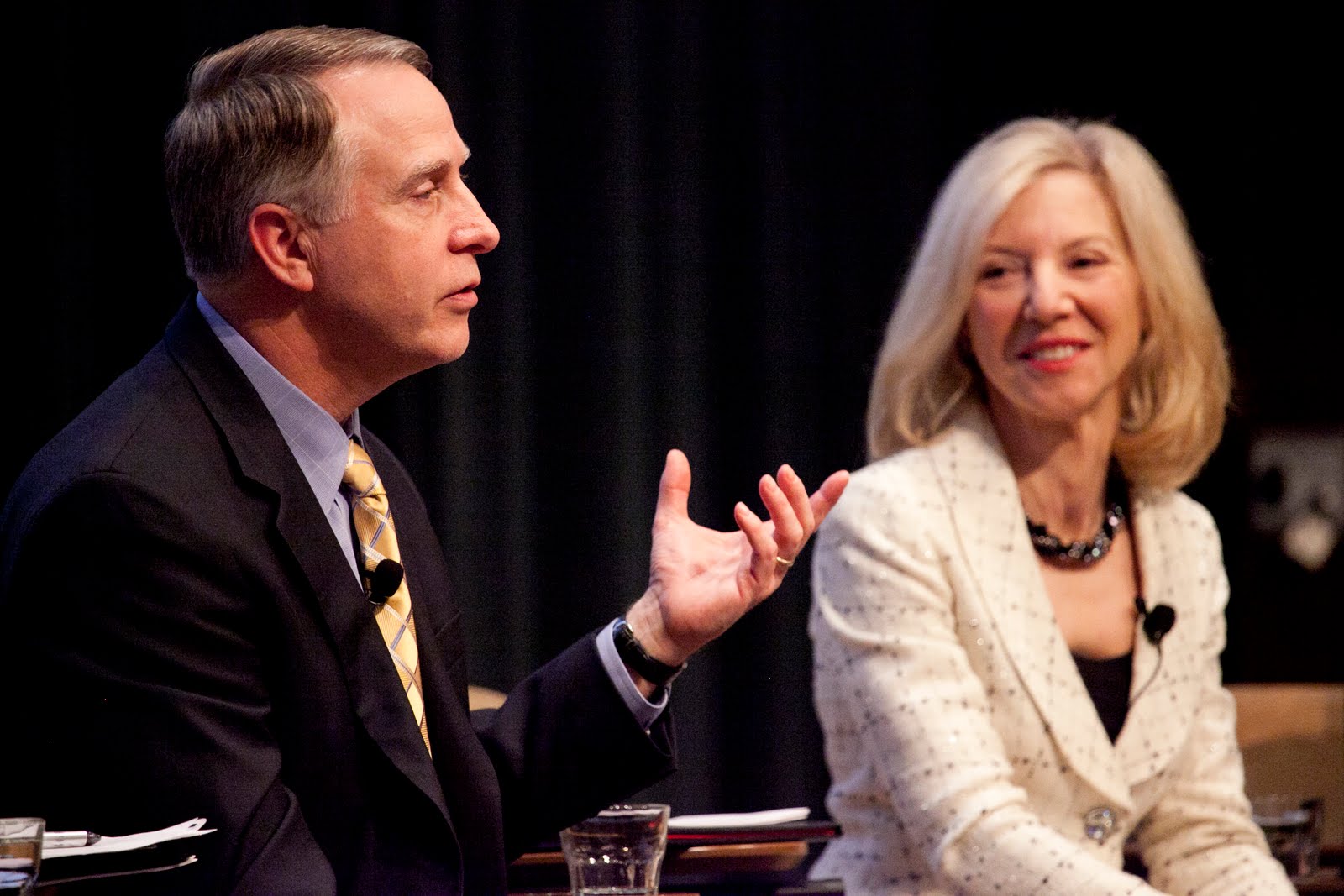
The event, which was the EAA's first in tandem with Penn, followed a two-day meeting at the CDC of the Presidential Commission for the Study of Bioethical Issues. Penn President Amy Gutmann is the commission chair, and Emory President Jim Wagner is vice chair. The evening also marked the first EAA event at the CDC, and if its success is any indication, it won't be the last.

From the beginning, Gutmann and Wagner had an easy chemistry. It helped make what in lesser hands would have been an impenetrable scientific wonkfest into an engaging, accessible, and enlightening conversation.

Moderators Kathy Kinlaw 79C 85T, associate director of the Center for Ethics at Emory, and Jonathan Moreno, David and Lyn Silfen University Professor and Professor of Medical Ethics and of History and Sociology of Science at the University of Pennsylvania, helped in that regard as well, keeping the conversation moving at a brisk, but not unrelenting, pace.

Following introductions, Wagner and Gutmann delivered opening statements, then traded answers on questions provided by the both the moderators and the audience. The pair played off each other well. Subjects included the definition of bioethics, an exploration of universities' roles in bioethical discussions, and much more.

The evening had many memorable highlights (No Strings Attached's pitch-perfect renditions of the University of Pennsylvania Anthem and the Emory Alma Mater was one) and lots of memorable quotes .... some of them are below, with moderator questions included where applicable.

Opening statements ...

Wagner: We need people who feel confident in our abilities to exercise judgment based on ethics and our ability to make decisions based on moral principle. And I suggest to you--in fact, I insist--that our colleges and universities may be almost exclusively the intellectual breeding ground to produce people and ideas to meet these vital and timeless needs of society.

Gutmann: It is really important to bring the theoretical together with the practical, both inside and outside our universities. It is wonderful to see how this is happening on the president's commission. Everyone here recognizes the importance of universities to furthering the disposition and the ability to deliberate among people who disagree. That's something that brings Jim and myself together--engineer and political philosopher, differences aside.

Bioethics ... what does it mean?

Gutmann: The expansion of science, technology, and medicine has called into question how doctors should treat their patients, what kind of hospital practices there should be, and what are the benefits and the risks of emerging technologies, such as synthetic biology, neuroscience, nanotechnology, and genetic engineering. Bioethics spans a whole range of questions about distribution of resources, the treatment of individual, vulnerable people, and also the best use of new, emerging technologies.

Wagner: In the early days, bioethics was almost entirely concerned with medical issues. But much of what we are talking about now in bioethics has to do with things we call 'organisms' that not too many decades ago we weren't even sure were life.

What does the future hold?


Wagner: It might not be far from the truth to imagine the last century as a century focused on technologies of transportation, communications, computing, and synthetic materials. We may now be in a century that one day will be called the bio-century.

How can universities foster ethical behavior?


Wagner: Many universities as part of their undergraduate curriculum have writing-intensive courses. You need so many "Ws" on a transcript. What would it mean if there were "E" courses? When a biology professor is talking about genetics, he or she would have the opportunity to introduce ethical considerations into the classes and the examinations.

Gutmann: When H1N1 broke out, there were big questions about the production of the vaccine and its distribution. Who gets it first? At how much cost? What are the best incentives for experimentation? For instance, if you experiment on human subjects, what do you owe them? All of these questions ... if universities don't ask them and try to come up with really good answers--even if they are not universally accepted answers, but at least well-reasoned answers, nobody else is going to do it.

What are the values and skills that university presidents bring to the commission?

Gutmann: One of the takeaways from this evening for all of us, I think, certainly from Jim and my own experience on the commission, is how far universities have come in demonstrating the importance of the integration of knowledge and how important it is to be committed to showing what knowledge can do for society.

Jim and I really believe that we are stronger as individuals and our institutions are stronger to the extent that we can attract an incredible diversity of really smart people and encourage them to want to work together to produce something--whatever it is--that is bigger and better than anything they can do by themselves.

-- Eric Rangus, director of communications, EAA